
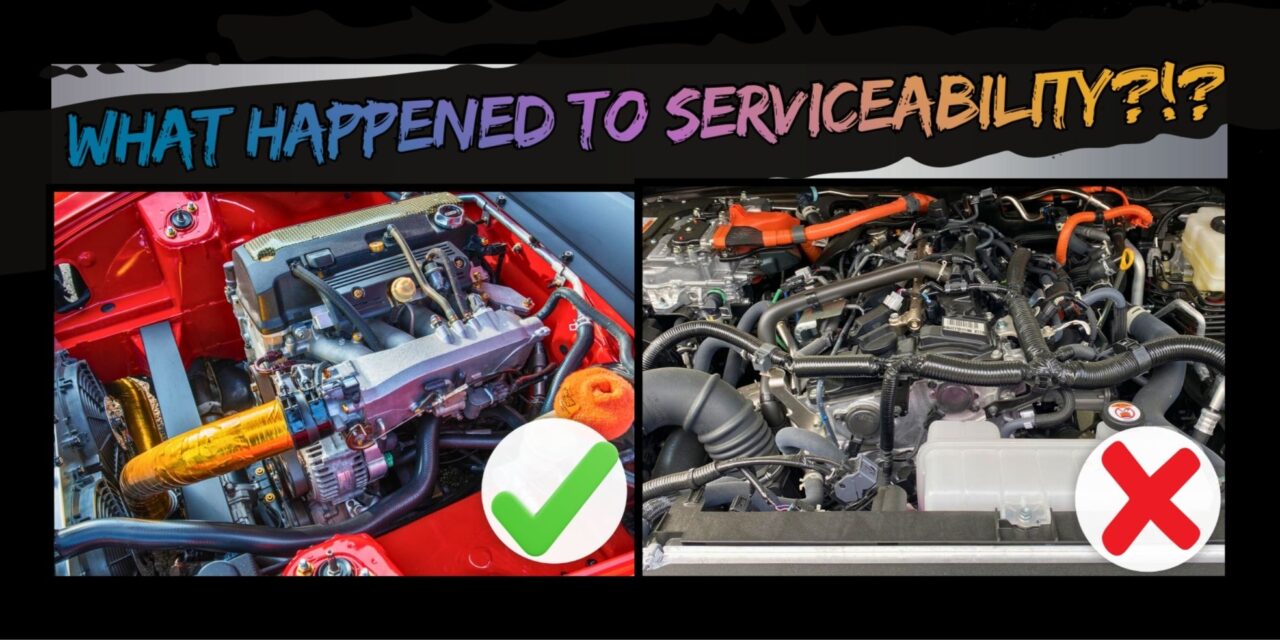

There was a time when changing an engine’s air filter meant popping the hood, unclipping a plastic box, and spending 5-minutes feeling like a competent adult. Today, depending on what you drive, that same “basic maintenance” can look like the opening scene of a teardown video. Bumper cover off, undertrays removed, wheel liners peeled, and a technician muttering words that would get you kicked out of church. I’m not exaggerating…
On certain Porsche Panamera configurations…
An air filter service can involve removing the front bumper cover and crash structure components, pulling wheels, dropping sections of liner and underbody protection, and stripping off cosmetic engine covers. Just to access a wear item that exists specifically to be replaced. We’re not talking about a turbo replacement… or a timing chain service. Nope – an air filter. The automotive equivalent of replacing a printer ink cartridge… if the ink cartridge required removing the front door of your house.
Bad design?? Or intentional, arrogant engineering??
We’ve reached a point where too many modern vehicles aren’t engineered to be serviced. Rather – they’re engineered to be assembled, leased, and turned back in – clean hands. New cars gleam in the showroom lighting. And the marketing team got their hero-shot at sunrise. Meanwhile – the poor tech who has to keep it alive at 110,000 miles… is basically playing automotive Jenga, pulling pieces & praying nothing snaps, cracks, or throws a code.
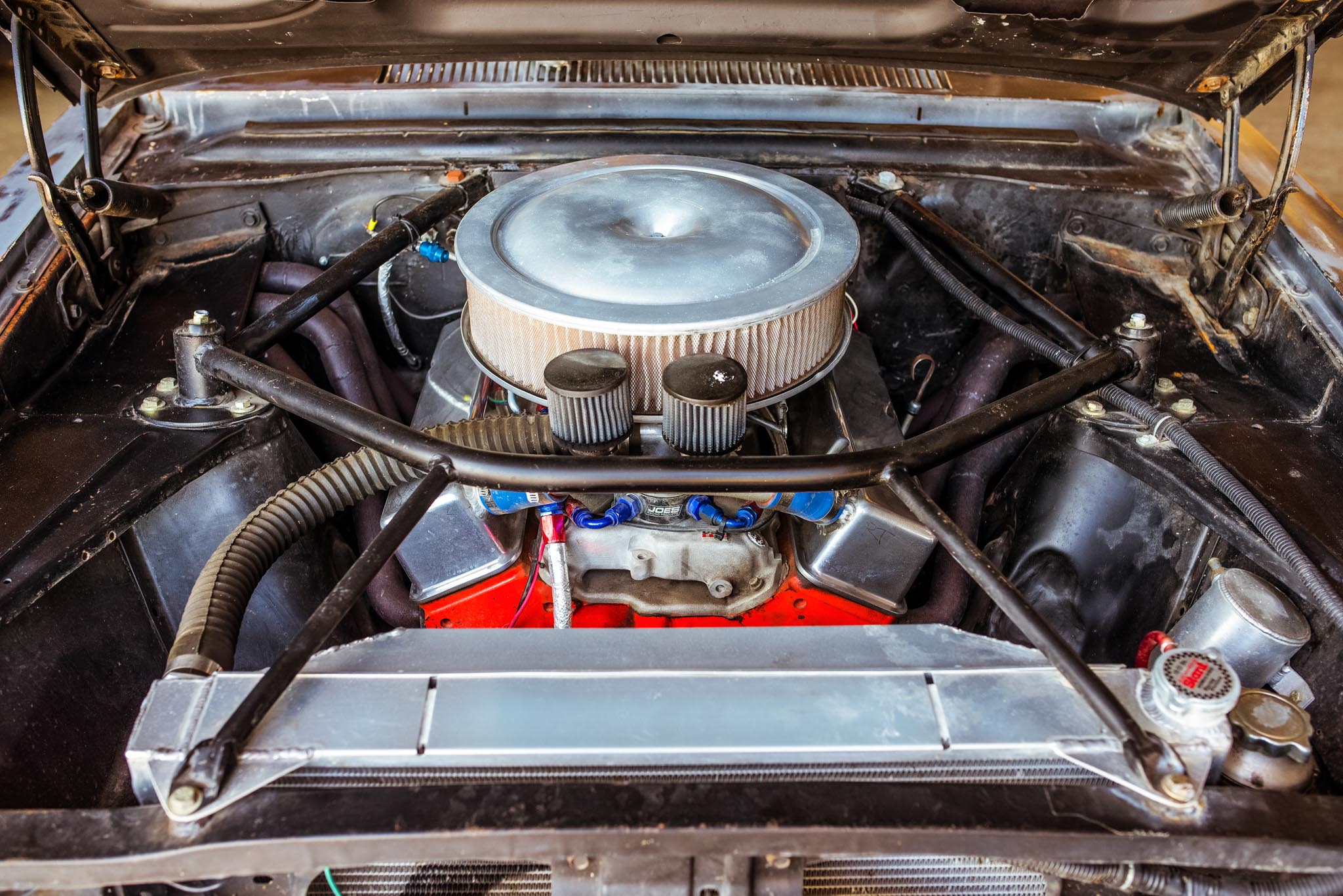
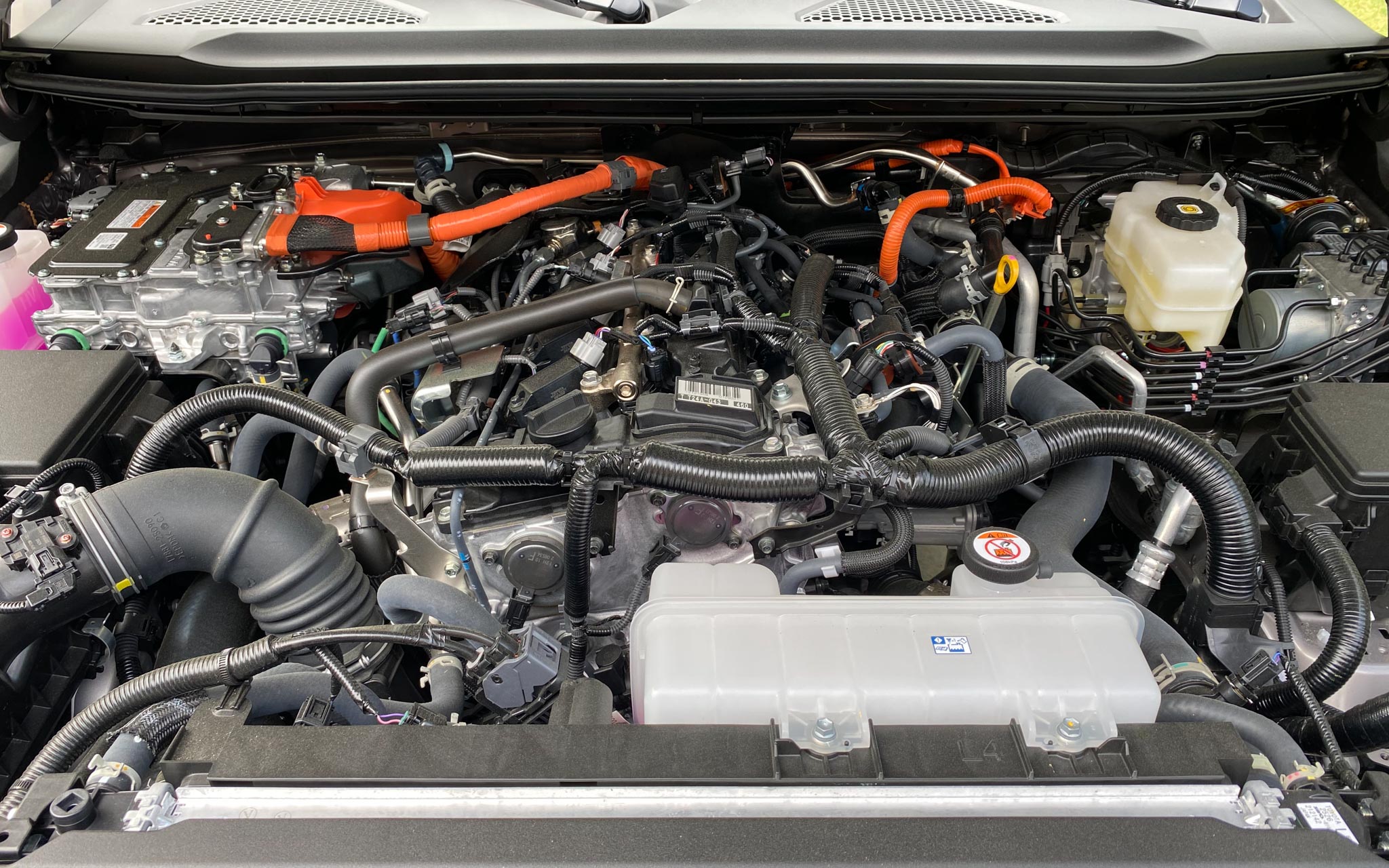

Modern packaging really is brutal – why??
To be fair, modern cars are more complex. These vehicles have more crash structure, more pedestrian-impact requirements, more emissions hardware, more turbo plumbing, more cooling circuits, more sensors, more wiring, more sound deadening, and more aero management than ever before. We’re trying to stuff the contents of a small electronics store into an engine bay that’s still expected to be sleek, low, quiet, and safe. Something’s gotta give.
Manufacturers will tell you the assembly line comes first…
And they aren’t wrong – at least from their perspective. If a design saves seconds-per-car in production, that’s millions in savings across a model run. A component that’s easy to install once at the factory… checks the box that matters most to the company. Serviceability doesn’t show up on the window sticker. Nobody test-drives a car and says, “Wow, what an accessible thermostat housing!” Rather, that pain shows up later… usually after the warranty honeymoon is over (coughs in GL63 AMG).
Carmakers also argue that regulations don’t reward serviceability…
There’s no federal standard that asks, “Can an air filter be accessed in under 10 minutes?” But there are stringent standards for crash performance, emissions compliance, evaporative leaks, pedestrian safety, noise, and fuel economy. Therefore – engineers optimize for what’s measured. They play the game by the rules. If service access isn’t measured, it becomes negotiable. All of that makes sense… but none of it is consumer-friendly. And none of it is a legitimate excuse for making routine maintenance so complex.
The real problem isn’t complexity… it’s priorities.
Somewhere along the line, carmakers stopped treating long-term maintenance as part of good engineering. And instead – they started treating it like something that needs to be handled by a dealer network, and a scan tool. The industry didn’t forget how to build cars. It forgot (or disregarded) who actually lives with them.

Just don’t touch it…
That’s become the philosophy of the modern car industry. And it’s shared with many modern consumers honestly. When & how exactly did that change? The car industry used to treat consumers like intelligent/capable adults. Now it’s, “We’ll take it from here lil guy.” Headlights that require bumper removal or wheel-well contortion to replace a bulb or module. Batteries moved under seats, behind trunk trim, or beneath layers of electronics – THEN tied to software procedures that punishes anyone without factory tools. Oil changes that used to be a 20-minute job… now turned into undertray archaeology, where you remove a dozen fasteners just to reach a drain plug – assuming the drain plug isn’t a plastic unit that feels like it belongs on a squirt gun.
And then there are the legendary “how did this ever get approved” moments…
Like the GM Northstar V8 starter placement. The Northstar was (on paper) a technological flex for its era: Smooth, high-revving, & modern. But the starter – a wear out item – was placed under the intake manifold in the engine valley. When that starter fails, the job isn’t “replace starter.” Rather it’s, “remove intake, disturb fuel and vacuum connections, replace gaskets, reassemble carefully, and hope nothing else breaks because the car is old enough to vote.” That’s not clever. That’s not premium. That’s a design choice that practically guarantees collateral damage, inflated labor, and/or an early grave for that vehicle.
It’s not just one engine or one company…
Plenty of transverse V6 layouts have created the same kind of misery… by burying half the service items against the firewall. Spark plugs on the rear bank become a knuckle-shredding ritual. Or worse – a procedure that involves lifting the engine or removing intake assemblies just to gain access. Timing service on certain modern engines has become so labor-intensive (because of where chains, guides, and tensioners are placed) that it turns a “maintenance interval” into a financial event or a new car purchase. There have been engines where timing chains are located at the rear of the motor, up against the transmission side, which can transform what should be a front-of-engine service into an engine-out or major disassembly job. That’s not always because engineers are clueless. It’s often because packaging targets, crash structure, and styling decisions forced components into the least accessible space available.
This is why I keep coming back to the uncomfortable truth:
The engineers don’t always get to design the vehicle. A lot of times, the engineer is handed a bucket of opposing obstacles, and told, “Make it work.” They become problem-solvers inside a very tight box. The design studio wants a certain silhouette. Marketing wants the “face”. Government regulations want MPGs, electrification, & safety. Emissions need plumbing. Turbochargers need more complex cooling systems. And all the modern electronics demand space for sensors, wiring, and batteries. At the end of the line, stands the engineer with his clipboard like, “WTF guys”.
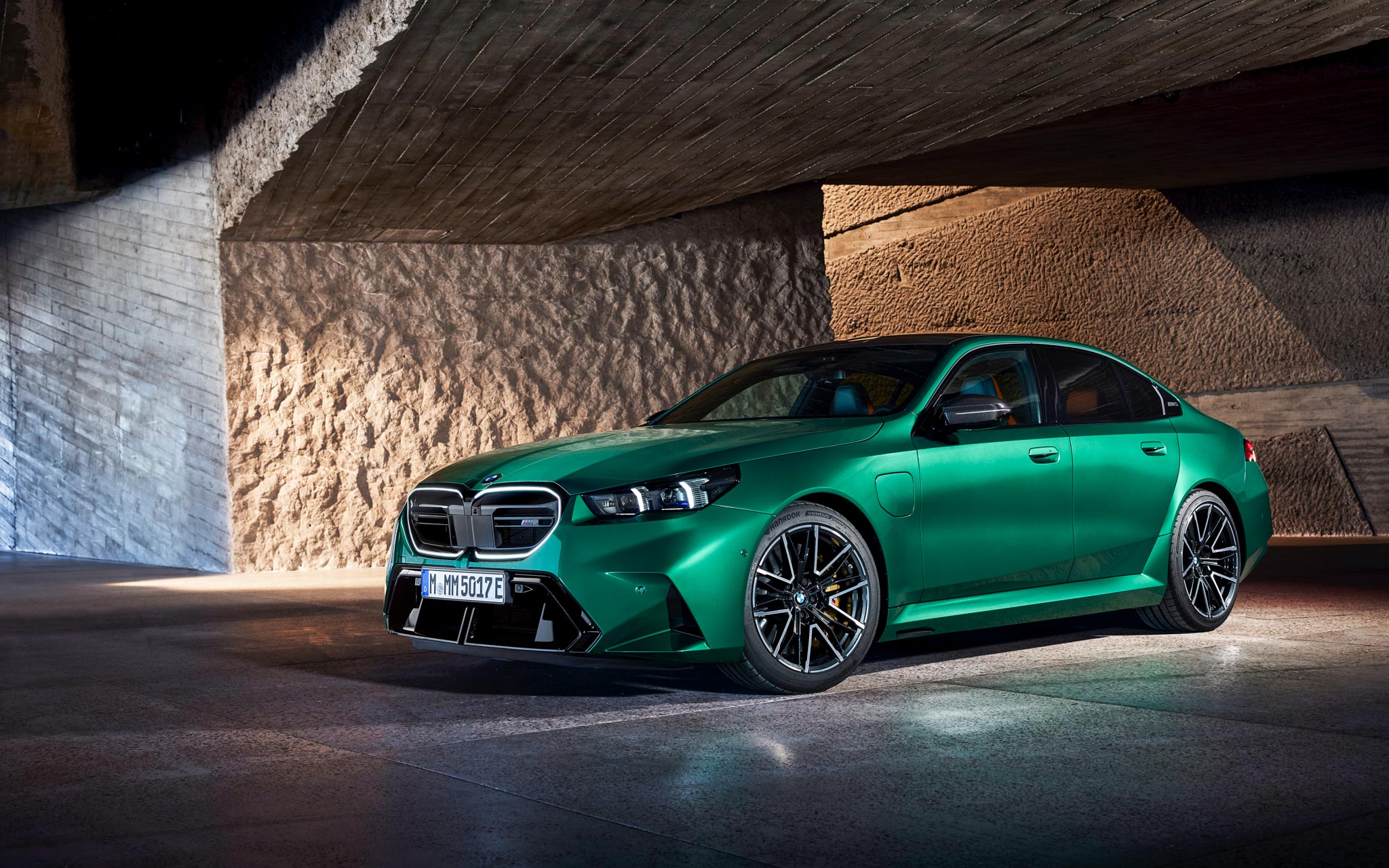

When that happens, serviceability doesn’t die in one dramatic moment…
It dies quietly, through compromise after compromise. You move one component, you add a bracket… and route a duct around a module. As a result, 1 service item new requires the removal of 3 unrelated parts. Eventually, you reach a point where the air filter needs a front-end removal procedure. And nobody in the meeting is personally/independently responsible… because it was death by a thousand edits.
This problem isn’t limited to high-end cars…
Luxury brands get blamed, because their cars are often densely packaged and style-forward. But you can find these decisions all over the market. Trucks and SUVs are getting underbody panels for efficiency. Entry-level cars are getting tightly-packed engine bays to meet crash standards and keep costs down. Even brands that historically made straightforward, owner-friendly vehicles have been pulled toward sealed, integrated, and “module-based” thinking… because it simplifies manufacturing and helps hit compliance targets.
And – the modern customer has trained manufacturers to get away with it…
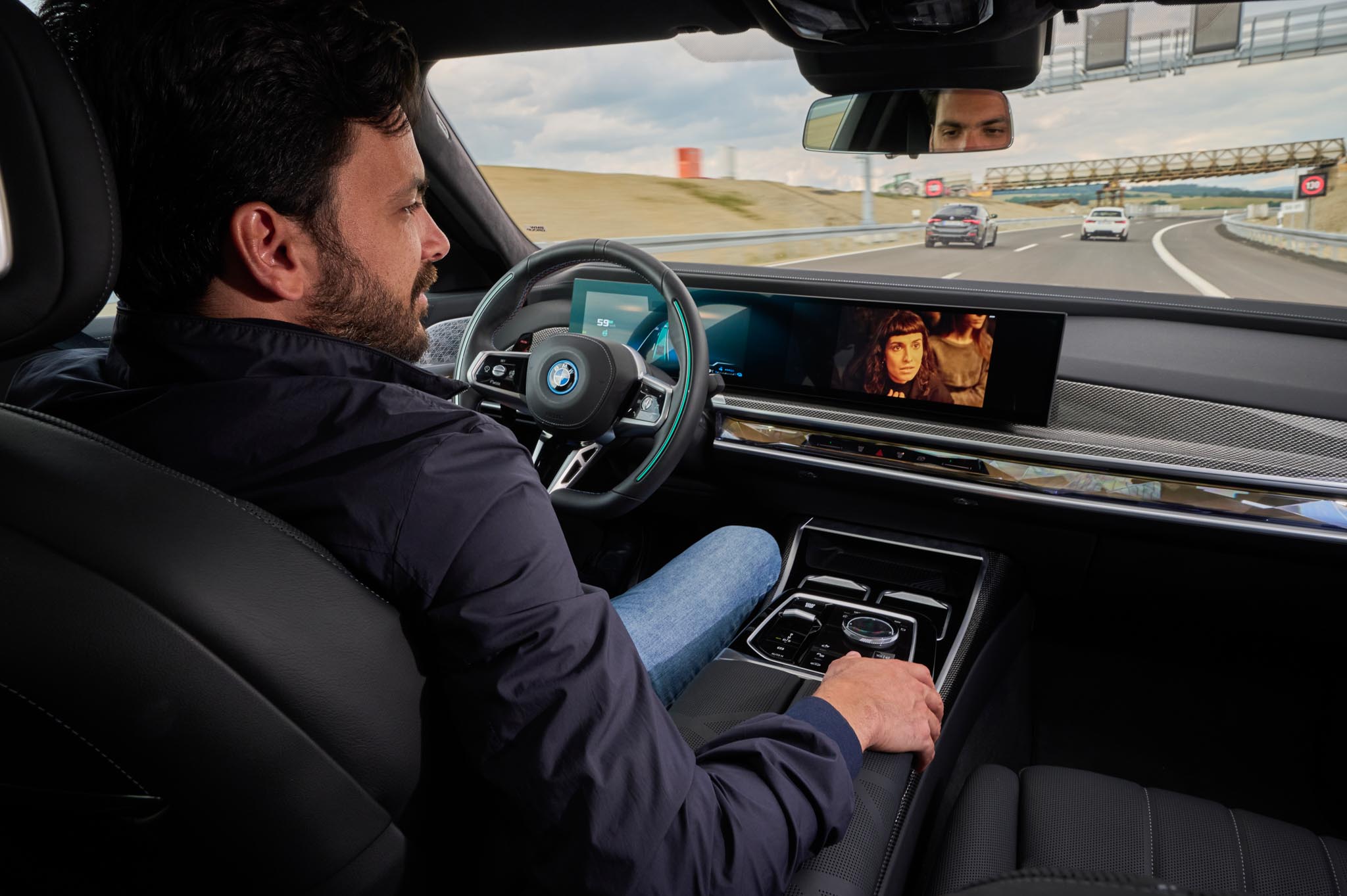
Most people don’t (want to) maintain their own cars anymore. In fact, most people couldn’t tell you a single thing about their cars. They want the car to behave like a smart phone – push button; car work. Carmakers see these modern trends in consumers, and figure, “They barely know how to pop the hood… you think they’re really ever gonna change the starter?? Just sell them an extended warranty & bring them back to the dealer, it’s a trade-in opportunity.”
If your “appliance” isn’t serviceable, it doesn’t stay “an appliance” – it becomes an expense with a much shortened lifespan.
This is where technicians get dragged into the story…
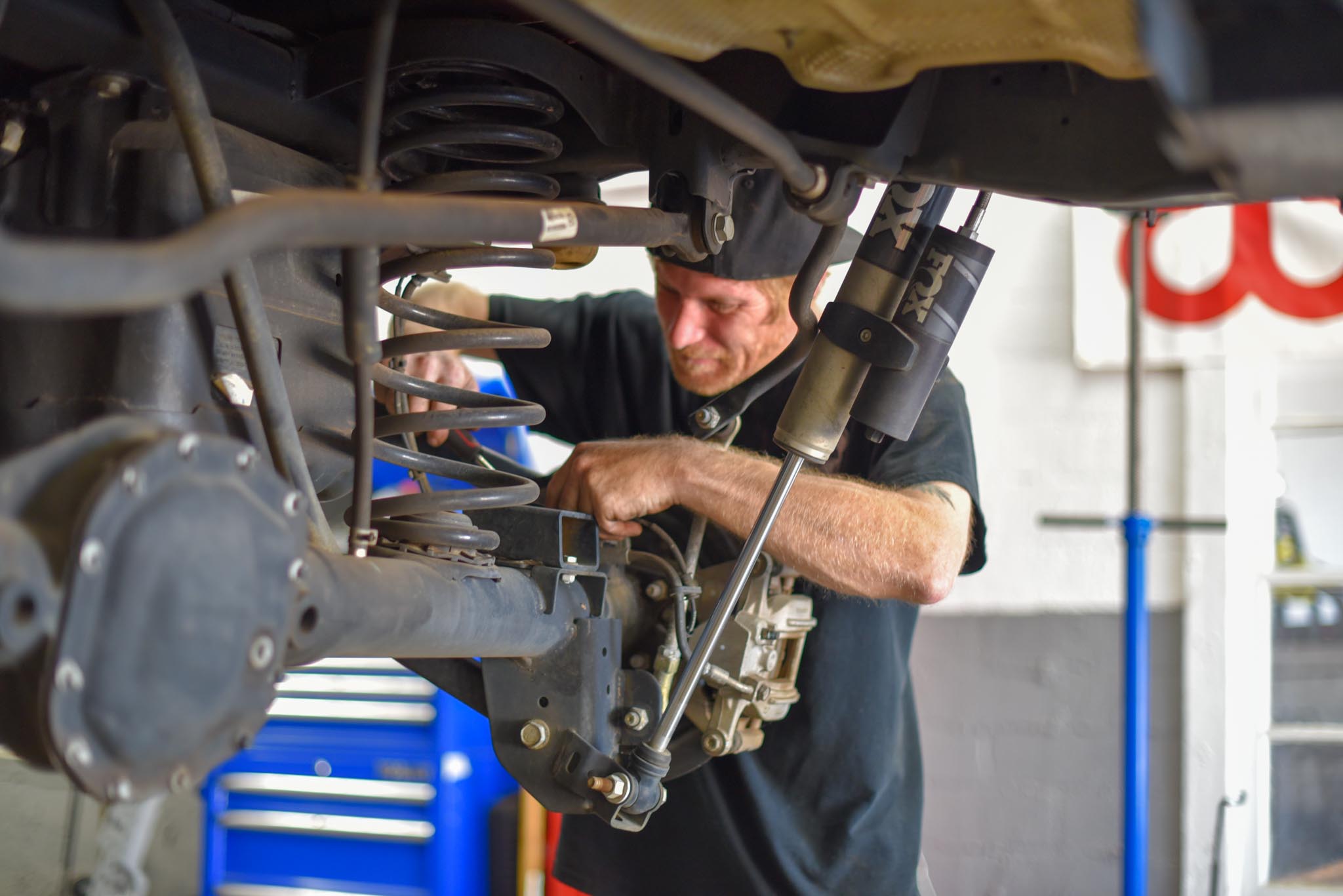
As the unwilling heroes – and sometimes the villains – depending on who’s telling it. Technicians are dealing with shrinking access, more fragile components, and more integrated systems that can’t be disturbed without creating new problems. The average shop isn’t sitting around trying to scam anyone. They’re trying to quote a job honestly & accurately… while knowing what could unravel. Design choices create risk, and risk creates cost. Owners feel that cost and blame the shop. The shop blames the manufacturer. The manufacturer points to “complexity & regulation”… and the circle continues.
That friction is part of why the Right to Repair conversation matters…
Even if most people only hear it when it’s framed as politics. The real value of Right to Repair isn’t just being able to “fix your stuff.” It’s pressure. If independent mechanics (and car owners) have access to tools, information, parts, and procedures… it changes the landscape. It weakens the idea that service can be captive, dealer-only, or software-gated. Also, it forces a broader public discussion about what a car should be allowed to become: A locked device you rent… or a machine you can maintain?
Right to Repair alone won’t magically move an air filter back to a sensible location…
But it can shift incentives. If manufacturers know the market expects service access, standard interfaces, and parts availability… they can no longer hide behind “authorized service only” as a way to justify pain. And if enough new car buyers start educating themselves (ie: if ownership-costs and maintenance-pain become a bigger part of purchase decisions), carmakers will feel it. Nothing changes faster than a trend that affects sales.
But I’ll go further than policy:
The cultural fix has to happen inside the companies. You can’t legislate empathy. You can, however, build it into the process. For example – if I ran a modern automaker’s product-development pipeline, I’d do something radical: I’d make the people who design these cars… work on them. Not as a team-building exercise. And not as a marketing stunt. But as a requirement. Designers should be required to perform basic maintenance tasks on prototypes with hand tools. Engineers should be required to do the same. Not because they’re ignorant – but because the act of doing it forces a different kind of thinking.
CAD doesn’t teach empathy. A wrench does…
When you’ve personally tried to access a fastener buried behind a harness, you start designing harness routing differently. And when you’ve personally replaced a bulb by feel with your arm wedged into a wheel well, you stop approving that layout as “acceptable.” When you’ve personally removed fifteen clips to reach a drain plug, you stop pretending an undertray is “just a cover”… and you start treating it like a service barrier that needs access panels & thoughtful design.
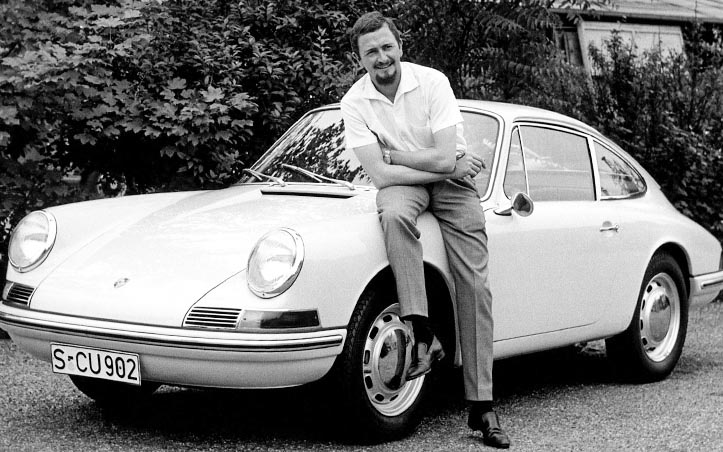
Butzi Porsche

This isn’t new thinking…
Plenty of great manufacturers historically had “service voices” in the room early. People whose job was to say, “Okay, cool, but how do we FIX it later?” Somewhere along the way, that voice got quieter. Or it got replaced by bean-counters who said, “Average ownership is X years, so this isn’t a priority.” They started designing for the lifespan of the warranty, and anything past that was irrelevant. That’s a poison calculation. It leads directly to the modern reality where a vehicle can be “reliable on paper”, yet miserable to maintain in practice. And misery becomes the dominant ownership experience.
A hard truth nobody likes saying out loud:
Sometimes these designs aren’t accidental. Sometimes they function as a moat. If the average car owner & independent shop can’t reasonably access service items, the vehicle becomes tethered to a dealership – including their labor, tools, parts pricing, and timelines. Even when that isn’t an explicit goal, it’s a predictable outcome… and companies aren’t blind to predictable outcomes.
That’s why “designed to look good, not to be touched” isn’t just a joke…
It’s a statement about how modern cars are increasingly built like locked consumer electronics. Sleek, integrated, sealed… and hostile to anyone who wants to maintain ownership past the warranty period. It’s why you see software and component pairing creep into places it never belonged. And it’s why a simple battery replacement can turn into a coding procedure. It’s why a sensor replacement can require calibration steps that feel like initiating a spacecraft launch sequence. You don’t need a tinfoil hat to see the direction of travel.
But to be fair yet again…
Some of this is legitimate safety & performance progress. Calibration matters. Sensors matter. Systems are interconnected for a reason. But progress becomes a problem when it’s implemented without respect for the service environment. A car can be advanced, and still be maintainable. Those are not mutually exclusive. The conflict exists because serviceability isn’t being treated as a design goal on equal footing with styling, cost, and compliance.
So what does better actually look like?
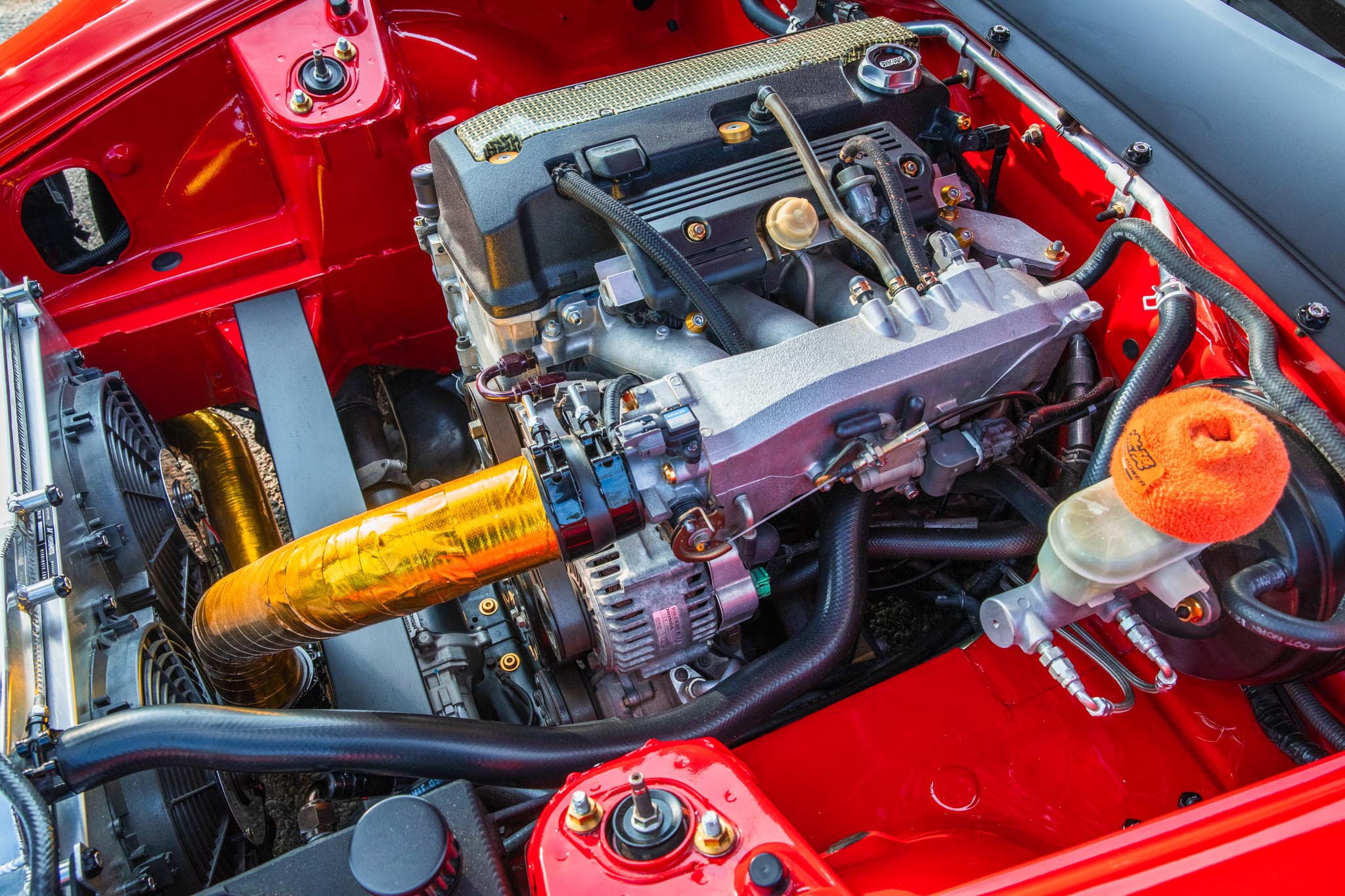
Better looks like routine wear items being placed where they can be accessed without structural disassembly. It looks like engineers being allowed to push back when a hood line or front fascia forces basic services into absurd labor. And it looks like standardized fasteners where possible, access panels where necessary, and durable clip systems that don’t disintegrate after a few heat cycles. It looks like the return of common sense, pride in quality & standing behind your product. If a part is meant to be replaced regularly, the car should not be built as if it will never need to be replaced (thinking about those non serviceable engine air filters on BMW I3’s).
Better also looks like accountability in the studio. If a designer wants an aggressive nose, fine. But that design decision should come with a service impact review that has real weight, not a checkbox. If the airbox has to move into a silly location because the front end is sealed, that should trigger a redesign discussion… not kicking the can down the road to a technician’s nightmare a couple years later.
And better looks like manufacturers re-learning that long-term owners exist. Enthusiasts exist. Rural owners exist. Fleet owners exist. People who keep vehicles well past the lease cycle – exist. These aren’t fringe customers – they’re the backbone of resale value, brand reputation, and the used market that feeds new sales. A brand can’t brag about residual value, and then act shocked that people are mad when basic maintenance costs feel like luxury-car punishment.

Here’s the irony:
The industry is so obsessed with designing cars that “feel premium”… that it forgets what premium ownership actually is. Premium isn’t just a stitched dashboard and ambient lighting. Rather, premium is a car that’s well-built through & through… and can be maintained for the long run – without drama. Premium is thoughtful engineering that respects your time, your wallet, and the fact that machines need care. It’s not just a badge on the hood. And/or nightmares hiding behind fancy headlights.
If you want to build cars people love long-term, you don’t start with a slogan…
You start with the ownership experience. That experience includes maintenance, serviceability, access, and repair. The Right to Repair movement may help push that reality back into the spotlight, because it challenges the idea that the owner is simply a user and the vehicle is a locked product. It reminds the industry that a car is still a machine… one that should be serviceable by design, not intentionally disposable.
And if the market wants a path forward that doesn’t involve turning every vehicle into a subscription service, it needs to bring serviceability back to the front of the room. Not as nostalgia. Not as “old man yells at cloud.” But as a practical requirement for sustainable ownership.
If we keep going the way we’re going, we’re not building better cars. We’re building better-looking burdens. And sooner or later, people are going to stop confusing those two things.
Article by David S. Windsor