
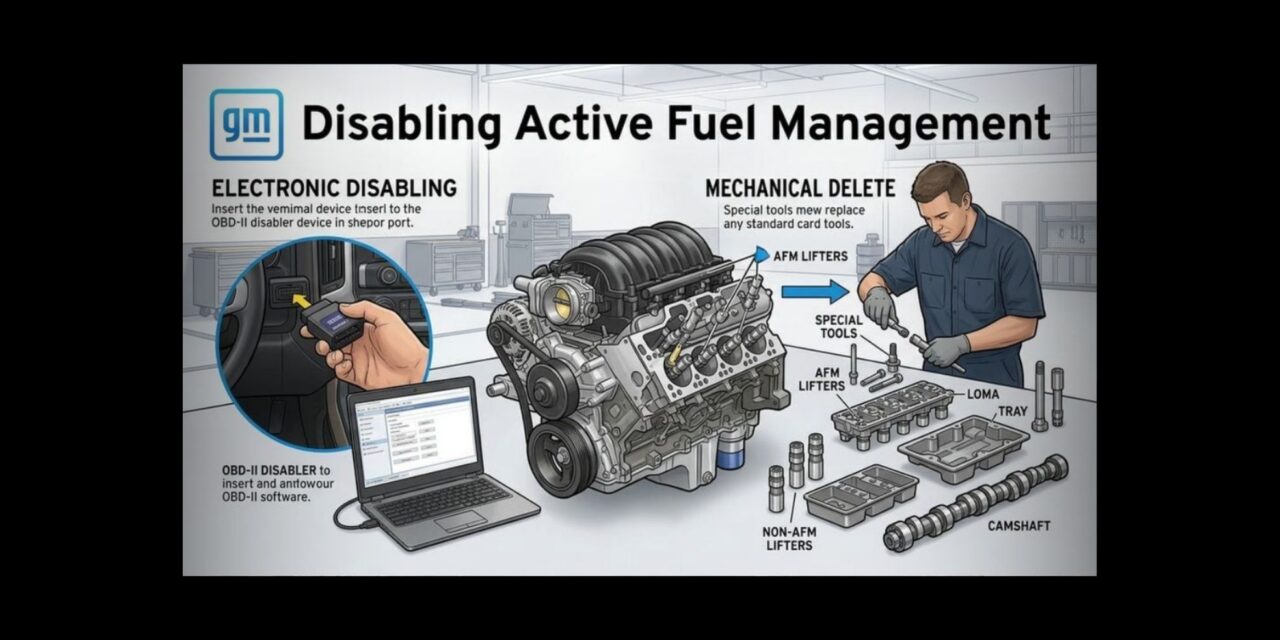

GM developed Active Fuel Management (AFM) for a simple reason: a V8 doesn’t need all eight cylinders running all the time. During steady cruising and other light-load conditions, AFM can deactivate four cylinders, letting the engine temporarily operate on 4 cylinders. When the driver asks for more torque, the engine returns to V8 operation. GM describes the system as a fuel-saving strategy, designed to reduce pumping losses when full engine output is unnecessary.
On paper AFM makes sense. But behind the wheel, not every truck owner likes the result.
Owners who pay close attention to engine response and exhaust sound may notice the change between cylinder modes. The difference can become especially obvious after installing a freer-flowing aftermarket exhaust. A V8 that sounds deep and even under acceleration can take on a flatter, less natural tone when AFM enters V4 mode.
There is another reason AFM gets so much attention: the system adds specialized valvetrain hardware. AFM-equipped engines use special lifters and oil-controlled components to deactivate selected cylinders. Lifter-related failures and valvetrain problems are legitimate diagnostic concerns on some GM applications. Although – simply disabling AFM electronically should not be confused with mechanically removing those components.
For an owner whose main goal is to stop cylinder-deactivation operation without opening the engine or permanently recalibrating the ECM, a plug-in AFM disabler offers a relatively simple approach. The device connects through the diagnostic port and prevents normal AFM operation while installed. Extension cables and adapters can also make the installation cleaner when access to the port is awkward.

Why Active Fuel Management (AFM) Ruins Your V8 Driving Experience
AFM itself does not reduce the engine’s maximum horsepower. When substantial power is requested, a properly functioning AFM-equipped V8 returns to eight-cylinder operation. The complaint is usually about what happens between those moments: changes in sound, feel, and cylinder-mode transitions during everyday driving.
That distinction matters. Disabling AFM should not be marketed as adding horsepower like a camshaft, intake, forced-induction system, or performance tune. Its attraction is keeping the engine in full-cylinder operation rather than allowing the ECM to command reduced-cylinder modes.
The Dreaded V4 Tone & Exhaust Drone
Exhaust sound is one of the easiest AFM changes to notice.
A conventional V8 exhaust note comes from the firing events of all eight cylinders. With traditional AFM active on a V8, four predetermined cylinders are deactivated under suitable light-load conditions. GM documentation identifies cylinders 1, 7, 6, and 4 on many AFM V8 applications.
The change in firing pattern changes what reaches the exhaust.
A stock exhaust system is engineered with cylinder-deactivation operation in mind, so the effect may be relatively subdued. Install a louder Flowmaster, Borla, MagnaFlow, or similar aftermarket system, however, and the difference can become much easier to hear.
Instead of the consistent V8 note the owner wanted from the exhaust upgrade, V4 operation can produce a less satisfying sound at cruising speeds. Depending on the exhaust configuration, engine speed, gearing, and cabin acoustics, that change may also coincide with noticeable low-frequency resonance or drone.
For enthusiasts who bought a V8 partly because they enjoy its sound, repeatedly switching between two exhaust characters can become irritating.
Throttle Hesitation & Sluggish Power Delivery
A properly operating AFM system is designed to move back into full-cylinder operation when additional power is required. GM states that medium-to-heavy throttle operation uses all eight cylinders on traditional AFM V8 applications.
That means AFM does not leave the truck stuck in V4 mode when the driver demands acceleration.
Still, some drivers dislike the sensation associated with cylinder-mode changes. Transmission behavior, throttle mapping, torque-converter operation, gearing, engine load, and AFM can all influence how a truck responds to small throttle inputs, so every hesitation should not automatically be blamed on AFM.
Keeping the engine in V8 mode removes one variable from that process. Rather than moving between V4 and V8 operation as load changes, the engine remains in full-cylinder mode. For drivers sensitive to these transitions, that can make normal cruising and tip-in response feel more consistent.
Plug-and-Play AFM Disablers: The Safest Way to Restore V8 Power
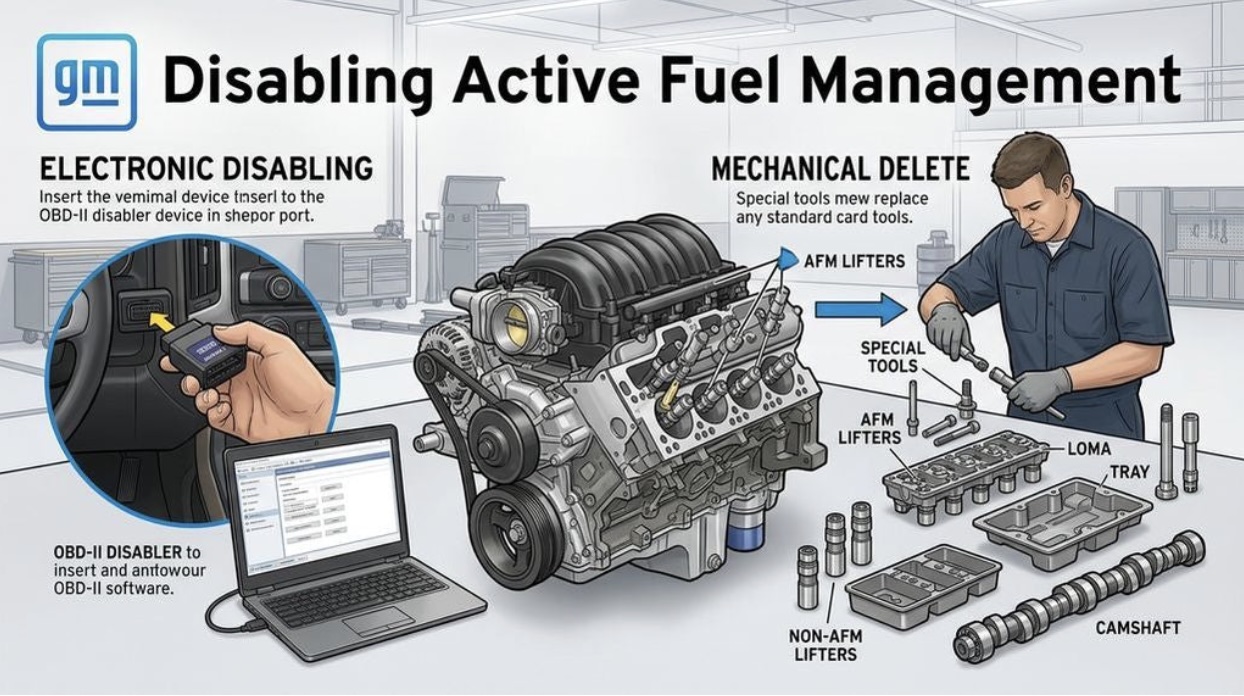
There are several ways enthusiasts approach AFM. A full mechanical delete can involve internal engine work and replacement valvetrain components. AFM can also be altered through ECM calibration on supported vehicles.
A plug-in disabler is much less invasive.
It does not require removing cylinder heads, changing lifters, replacing a camshaft, or permanently flashing a calibration simply to prevent cylinder-deactivation operation. It is also removable, making it attractive to owners who do not want to make permanent mechanical changes.
There is an important limitation though: an electronic AFM disabler is not a mechanical AFM delete. The AFM lifters and related hardware remain inside the engine. A disabler should therefore not be presented as a guaranteed cure or preventive repair for a lifter that is already damaged.
How OBD2 AFM Disablers Work
The OBD-II connector beneath the dashboard provides access to vehicle diagnostic networks and power. Compatible AFM disablers use this connection to communicate with the vehicle, so that cylinder-deactivation operation remains disabled while the device is connected.
Unlike an ECU tune, this type of installation does not require the owner to rewrite the factory calibration. The EGR Performance unit specified for this article, for example, is marketed as a plug-and-play AFM/DFM disabler for supported GM applications, and is designed to operate through the 16-pin OBD-II connection.
Owners should still confirm the exact year, engine, ECM strategy, and vehicle compatibility before ordering. AFM and the later Dynamic Fuel Management (DFM) system are not identical. DFM can deactivate cylinders in multiple combinations rather than simply switching a V8 between eight and four cylinders.
Warranty claims also deserve caution. Installing an aftermarket device does not automatically erase an entire U.S. vehicle warranty simply because the part is aftermarket. At the same time, warranty coverage may be denied for damage shown to have been caused by an aftermarket component or modification.
Choosing the Right Setup for Hard-to-Reach OBD Ports
The diagnostic connector is normally under the driver’s side of the dashboard, but that does not mean every plug-in device sits neatly once installed.
A module protruding directly from the connector may be inconvenient around a lower dash panel or driver’s footwell. Owners may also need the diagnostic connector for a scan tool or another compatible accessory.
In these situations, installing a GM AFM disabler with an OBD2 extension cable can move the module away from the factory socket, and provide more flexibility in routing it under the dashboard.
A low-profile cable is particularly useful when the goal is to keep the module from hanging directly below the dash. Secure the cable so it cannot fall near the brake or accelerator pedal, steering components, or the driver’s feet.

Compatibility & Hardware Solutions Across GM Model Generations
AFM has appeared across numerous GM cars, trucks, and SUVs, but compatibility should always be determined by the actual powertrain – not merely by seeing a Chevrolet or GMC badge.
Modern GM Trucks vs. Classic & Transitional Configurations
Silverado, Sierra, Tahoe, Suburban, Yukon, and related GM platforms have used different engines and cylinder-deactivation strategies across generations.
Traditional AFM is essentially an all-eight-or-reduced-cylinder strategy on applicable V8s. Newer DFM is considerably more sophisticated. GM describes DFM as being able to use multiple cylinder configurations according to torque demand and efficiency requirements.
This is why a broad statement such as “fits every 5.3L Silverado” is not good enough. Two trucks carrying the same engine-displacement badge but built in different generations may use different engine management hardware and strategies.
Before buying a disabler, check:
- Vehicle year and model
- Engine family and displacement
- Whether the engine actually has AFM or DFM
- ECM/communication compatibility
- Manufacturer’s published fitment information
The product page supplied for this article currently lists its disabler for specified GM V6 and V8 AFM/DFM applications from 2005–2020, but owners should verify their exact vehicle against current fitment information rather than relying on year range alone.
Adapting Legacy Port Designs for Older GM Platforms
This is where terminology can confuse.
OBD-I-era GM vehicles predate the modern standardized 16-pin OBD-II connector, and traditional GM AFM appeared much later. Therefore, an OBD-I-to-OBD-II physical adapter does not magically give an older OBD-I engine AFM, or make an AFM disabler electronically compatible.
Adapters are more relevant to specialized wiring arrangements, engine swaps, diagnostic configurations, or installations where connector and pinout differences must be accommodated.
If a custom build genuinely requires using a GM AFM disabler w/ OBD1 to OBD2 adapter setup, verify more than the shape of the connectors. The ECM, communication protocol, power and ground pins, diagnostic wiring, and disabler itself all need to be compatible.
Never assume that because two connectors can physically be joined, the electronics behind them can communicate.

Step-by-Step Guide: Installing Your AFM Disabler in Under 2 Minutes
On a compatible vehicle with an accessible OBD-II port, the physical installation is usually straightforward.
- Park the vehicle and switch it off.
Set the parking brake and allow the vehicle electronics to power down according to the device manufacturer’s instructions.
- Locate the OBD-II port.
Look beneath the driver’s side dashboard, generally around the steering-column/lower-dash area. Identify the 16-pin diagnostic connector before plugging anything in.
- Check clearance.
If the module would protrude into the footwell or interfere with trim, use the appropriate extension or splitter. Route and secure the cable away from pedals, steering components, and moving parts.
- Connect the disabler.
Seat the connector fully without forcing it. On devices equipped with an indicator light, check the manufacturer’s instructions to determine what the light pattern means. The specified EGR Performance product uses an indicator as part of its installation procedure.
- Start the vehicle and verify operation.
Do not rely solely on an LED to determine that AFM or DFM is disabled. Verify operation according to the device instructions and vehicle instrumentation where applicable. If warning lights, diagnostic trouble codes, unusual drivability, or communication problems appear, disconnect the device and diagnose the problem rather than continuing to drive with an unexplained fault.
Remember that disabling cylinder deactivation can affect fuel economy, because the original system exists specifically to reduce fuel consumption during low-load operation. GM has documented fuel-economy benefits from AFM under suitable conditions.
Conclusion
For GM V8 owners who dislike cylinder-deactivation behavior, an AFM disabler offers a simple way to keep a compatible engine operating in full-cylinder mode without opening the engine or permanently recalibrating the ECM.
The biggest practical change is consistency. The exhaust retains its normal full-cylinder character, particularly noticeable with an aftermarket exhaust, and the engine no longer cycles into traditional AFM V4 operation during light-load cruising.
A plug-in device is also reversible: remove it, and the factory cylinder-deactivation strategy can operate again, assuming the vehicle remains otherwise stock and functional.
Just keep expectations realistic. An AFM disabler does not create additional peak horsepower, repair a failed lifter, or physically remove AFM hardware. Its job is much narrower: prevent cylinder-deactivation operation on a compatible vehicle while the module is installed.
Choose the disabler by engine and vehicle compatibility, not just the GM model name. If dashboard clearance is poor, an OBD-II extension or splitter can provide a cleaner installation. If a custom or swapped platform uses nonstandard diagnostic wiring, confirm the pinout and communication protocol before introducing an adapter.
Done correctly, the result is exactly what many GM V8 owners are looking for: consistent eight-cylinder operation, a steadier V8 exhaust note, and a reversible installation without an internal engine teardown.