
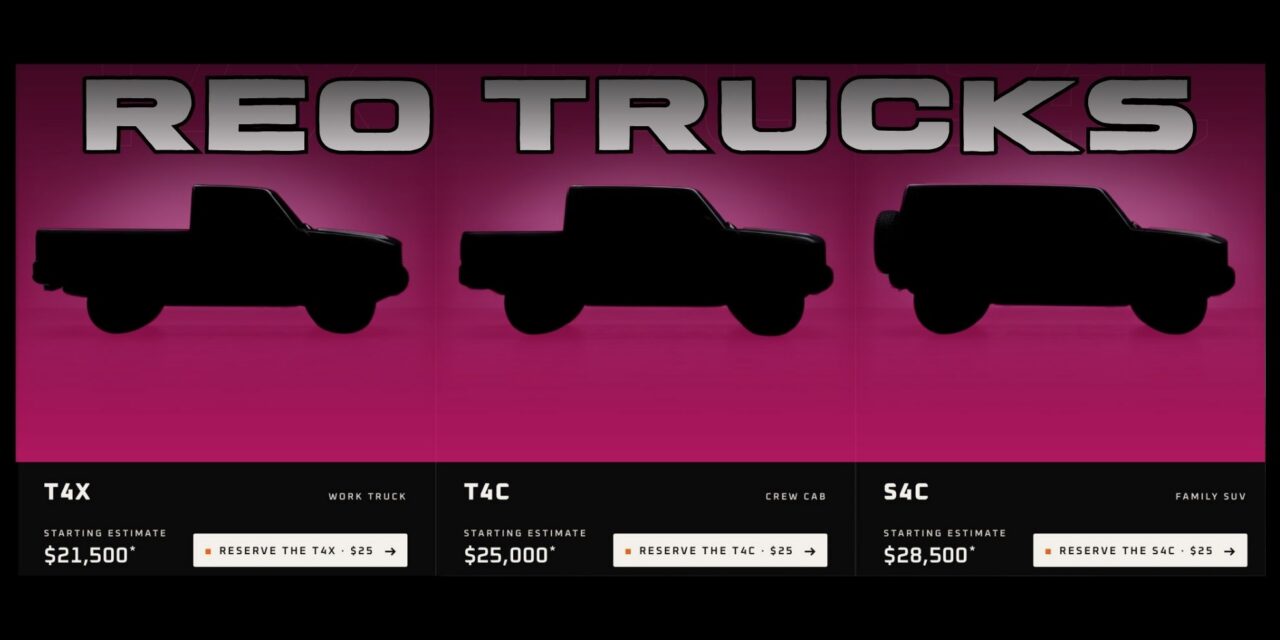

REO Trucks: The return of an American truck legend, the fight for mechanical freedom, and a startup daring to make simplicity desirable again.
There was a time when buying a truck meant buying a machine that was expected to work. Not pamper you… and definitely not monitor your behavior. Trucks of yesteryear didn’t ask for a monthly subscription to access something already installed at the factory. It just worked… and you went about your business. If something broke, you grabbed your tools, popped the hood, and figured it out.
Today, you can spend $70,000, $80,000, or even $100,000 on a pickup – and still find yourself at the mercy of proprietary diagnostic equipment, software-controlled components, and dealership service departments. We’ve somehow arrived at a point where the average pickup truck has enough computing power to coordinate a small military operation, yet replacing certain electronic components can require manufacturer authorization.
Now before some of you interject – yes – modern trucks are more powerful. They’re also safer, cleaner, and more capable than anything we had thirty years ago. You’re absolutely right. Modern engineering has given us remarkable advancements in crash protection, emissions control, powertrain efficiency, and towing performance.
But here’s a question that doesn’t get asked nearly enough: At what point did improving the truck become more important than improving the experience and purpose of owning one?
Well, somewhere in Texas, a company operating under one of America’s oldest automotive names has decided to ask that question. And rather than developing another enormous luxury pickup with a tablet glued to the dashboard…
REO Industries is proposing something remarkably fresh AND old-fashioned.
An affordable truck on a real frame with mechanical four-wheel drive. It has physical controls, and an engine designed to last. Also – a manual transmission if that’s your preference. And perhaps most interestingly – a truck engineered with the expectation that its owner might eventually decide to take the original engine out and install something completely different.
Now THAT has my attention.
A Name That Predates Most of the Automotive Industry…
Before we get into what REO wants to build, we need to talk about the name. Because this isn’t just a random collection of letters dreamt-up by a marketing department over overpriced coffee. REO stands for Ransom Eli Olds. Yes – that Olds. The same man responsible for Oldsmobile, one of the most significant names in American automotive history.
Ransom E. Olds was building automobiles before most Americans had even seen one. His Curved Dash Oldsmobile became one of the earliest mass-produced automobiles in the United States, helping establish manufacturing methods that would influence the entire industry. After disputes within the Olds Motor Works organization, he departed and established a new company in Lansing, Michigan in 1904. Automobile production followed in 1905. Ransom couldn’t simply take the Oldsmobile name with him, so he used his initials instead.
R.E.O.
And unlike ‘the modern automotive executive’ who might spend an entire board meeting debating the emotional significance of a new corporate logo & its hashtags… Olds simply focused on building vehicles. REO eventually became famous for its trucks. Particularly – the Speed Wagon – introduced in 1915. These machines helped establish the company’s reputation for commercial vehicles that could withstand the punishment of daily work. Over the decades, REO produced everything from passenger cars to heavy-duty trucks… becoming part of America’s industrial & transportation history.
But the original company wasn’t immortal. It went through corporate changes, mergers, and financial difficulties, with the historic REO operation ultimately disappearing in the 1970s. The name, however, never entirely disappeared from automotive memory. And now, more than a century after Ransom Olds first put those initials on a vehicle, REO is attempting a comeback under founder and CEO Zach De Bernardi.
The modern REO is based in Dallas, Texas, rather than Lansing, Michigan.
It IS NOT a continuation of the original manufacturing operation, and nobody should confuse the historic reputation of REO with this new venture. Nevertheless, there’s something fitting about reviving a name associated with practical trucks… and then committing to actually building practical trucks at practical prices – regardless of inflation.
Because… when did a truck become a luxury apartment?
Think about the evolution of the American pickup truck…
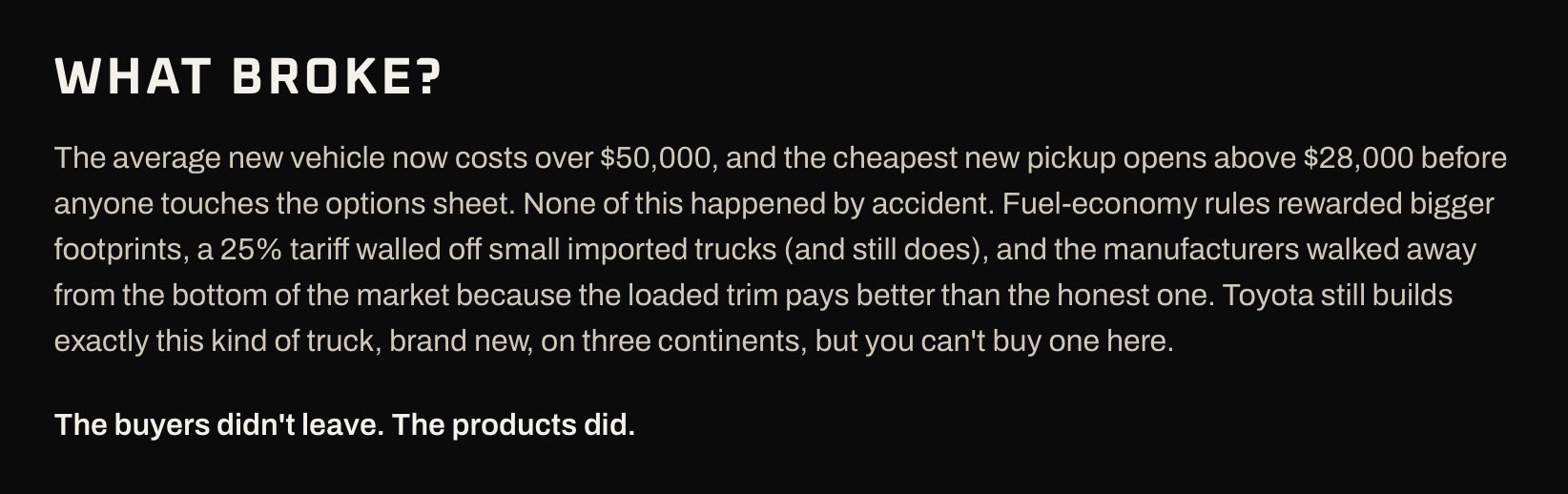
Not just its capabilities, but its purpose. For generations, a pickup was something you purchased as a tool… a workhorse. You could buy one with rubber flooring, manual windows, vinyl seats, and a bench wide enough for three adults. Air conditioning was an option. Power windows were a luxury. A radio was something you could replace on your lunch break. And if you wanted a nicer truck, manufacturers would happily sell you one. There was nothing wrong with that.
The problem isn’t the existence of luxury trucks; The problem is what happened to the affordable alternatives.
Over time, trucks grew larger & larger. They got more complicated, and considerably more expensive. And let me interject here, because I don’t want anybody thinking I’m against a fully loaded pickup. I’ve owned trucks on both ends of the spectrum, and there’s something immensely satisfying about putting a truck through a hard day’s work… while sitting in a cabin more comfortable than most people’s living rooms. Heated & ventilated leather seats, a fantastic sound system, enough power to pull a house off its foundation, and a suspension that doesn’t rearrange your spine every time you hit a pothole. What’s not to love?
Customers willing to pay a premium for luxury & capability have made high-end pickups incredibly profitable. So naturally, the industry has followed the money. The problem is that prioritizing those buyers has gradually narrowed the choices for everyone else. Affordable, straightforward trucks haven’t disappeared entirely, but even the basic models have become more expensive and increasingly complicated.
Take someone like me. I appreciate a fully loaded luxury truck just as much as a bare-bones workhorse. Most of my vehicles have come from the secondhand market. And one thing I’ve always appreciated about older trucks – even the well-equipped ones – is how easily you could make them your own. Modify the suspension, upgrade the stereo, swap the engine, or completely rework the interior. Today, so many systems are electronically interconnected & proprietary – that even relatively simple modifications can require specialized diagnostic equipment, software programming, or a dealership visit.
And buying one isn’t necessarily much better. Want a particular feature? You may have to purchase an entire package of equipment you don’t need just to get it. I understand the manufacturing efficiencies behind bundled options & integrated systems, but what’s convenient & profitable for the manufacturer isn’t always beneficial to the owner.
None of this means the buyer who wants a rolling executive lounge should have fewer choices.
Keep building those trucks! But what about the contractor who needs dependable transportation and a useful bed? The farmer who wants something that can get muddy without worry? The young enthusiast who wants an affordable blank canvas to modify? Or the family that simply wants a durable, reasonably priced truck without payments resembling a mortgage?
The issue isn’t luxury itself. It’s that simplicity, affordability, and the freedom to work on something you own have become increasingly difficult to find in a new truck.
That’s the wide open lane for REO…
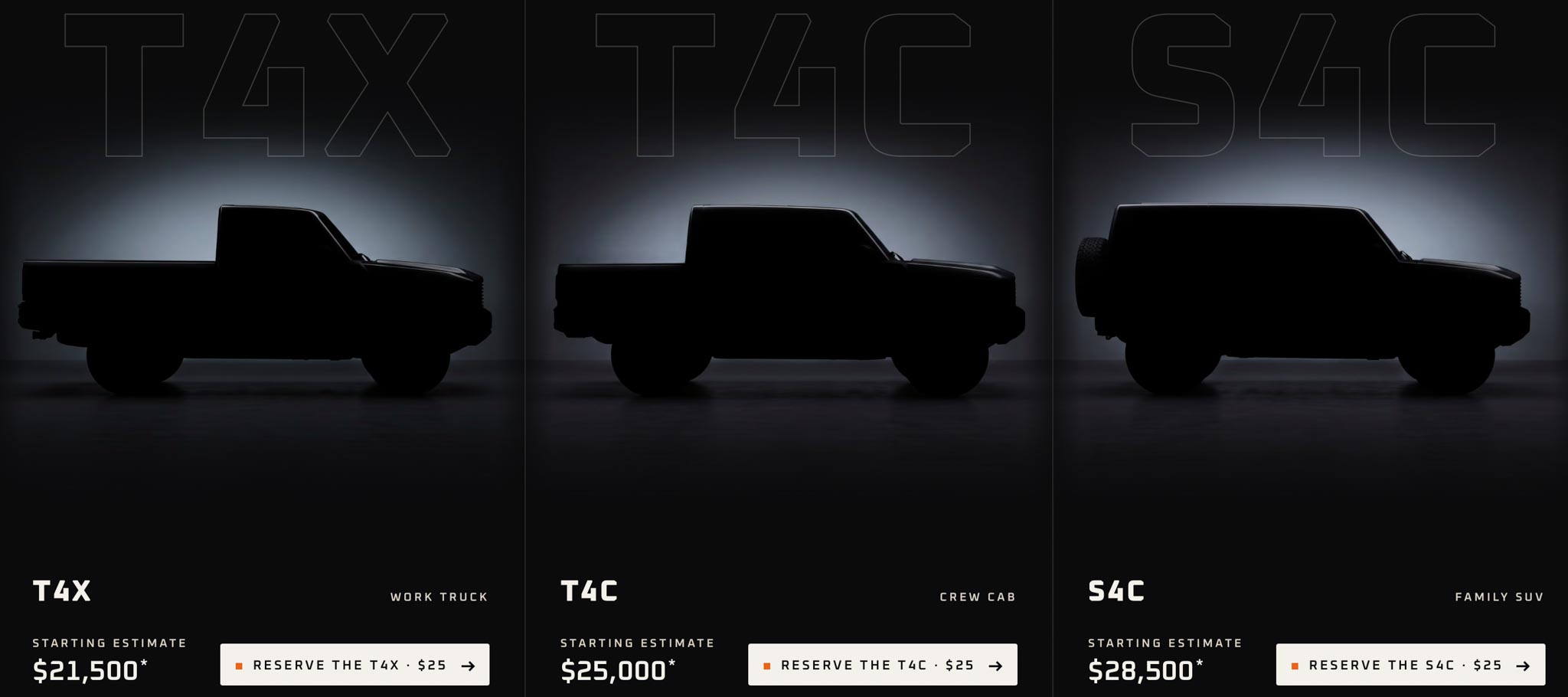
The Runabout: 3 vehicles, 1 philosophy. REO’s proposed Runabout lineup consists of 3 vehicles: The T4X work truck, the T4C crew cab, and the S4C SUV.
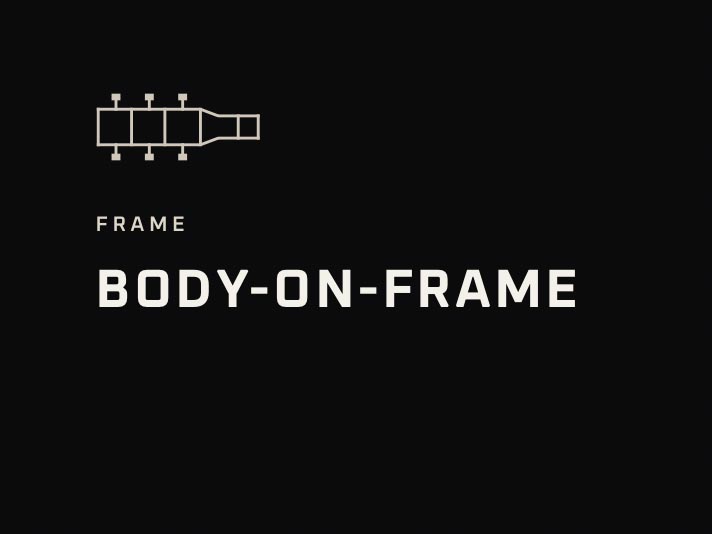
Rather than engineering 3 unrelated vehicles, REO intends to develop them around a shared body-on-frame architecture. Common components, shared powertrains, and interchangeable service parts should theoretically reduce development complexity, manufacturing costs, and long-term maintenance expenses.
It’s not revolutionary engineering. Manufacturers have shared vehicle platforms for generations. What’s different is how REO intends to use that philosophy.


The entry-level T4X…
Carries a projected starting price of $21,500. REO is targeting a naturally-aspirated gasoline 4-cylinder, mechanical four-wheel drive, a 6-speed manual (or automatic) transmission, approximately 4,500lbs of towing capacity, a claimed range approaching 600-miles on a tank of fuel, and a 500,000-mile powertrain lifespan.
That last number deserves attention. Half a million miles isn’t something you achieve by writing an ambitious number on a website. It requires careful engineering, testing, materials selection, quality control, and an understanding of how components deteriorate over years of actual (not theoretical) use. For now, these are development targets rather than independently verified production specifications. The final truck could differ significantly from what REO is advertising today. Still…
The proposed approach is refreshing.
A naturally aspirated 4-cylinder might not make anybody weak in the knees at a stoplight, but it makes sense for an affordable work truck. Fewer performance demands can mean less thermal stress and potentially simpler maintenance, depending on the final engine design.
A conventional frame offers flexibility for different bodies and vocational applications. Mechanical 4WD reduces reliance on certain electronic control systems. If you’ve read our articles in the past, then you know how we feel about too many electrical systems. Shared components make inventory management easier for both the manufacturer and independent repair shops.
Even the interior philosophy seems deliberately restrained.
REO says it wants analog gauges, physical switches, and a small display reserved for diagnostics and smartphone integration.
Imagine that. A dashboard designed around operating the vehicle rather than convincing its owner that every available surface needs to illuminate.
REO doesn’t seem to just be another empty promise…
They have partnered with Frank Stephenson’s design studio – whose portfolio includes the modern MINI, Ferrari F430, Maserati MC12, and McLaren P1. That’s quite an interesting résumé for somebody now helping design a budget work truck. But perhaps it’s exactly the kind of design experience REO needs. The original MINI revival demonstrated that an inexpensive, practical vehicle could still have character. A simple truck doesn’t need to be ugly and/or uninteresting, and an affordable vehicle doesn’t need to feel disposable.

Omnimount: Now We’re Talkin’
This is where REO goes from being an interesting proposition… to something that should get the real attention of enthusiasts, fabricators, independent shops, and aftermarket manufacturers. In October 2026, REO Trucks Blog published details of an exchange with REO Industries concerning engine swaps. The blog asked how accommodating the Runabout’s engine compartment would be for alternative powertrains and whether modifying the drivetrain would affect warranty coverage.
According to the October 20th post, REO described an engine-mounting system called Omnimount. The concept is intended to accommodate not only the truck’s original engine… but popular aftermarket powerplants, including General Motors’ LS family, Ford’s Coyote V8, and Honda’s K-series.
Separately, an October 17th post attributed to REO Industries discussed designing the engine mounts and transmission tunnel to accommodate swaps such as the LS, Honda K-series, and BMW B58. That gives us additional evidence that the idea is part of the company’s publicly stated design intentions. Although the precise list of supported engines remains something REO needs to clarify.
Let’s stop and let that truly sink in.
A manufacturer is talking about designing a new vehicle around the possibility of other manufacturer’s engine swaps?! imagine purchasing a compact body-on-frame truck that was engineered from the beginning to make swaps easier.
An affordable platform that anticipates modification.
Of course, engine mounts are only part of the equation. Anyone who’s actually performed a drivetrain swap knows that physically bolting an engine into the vehicle is often the easy part. Cooling systems, exhaust routing, transmission compatibility, driveshaft angles, accessory placement, wiring harnesses, fuel delivery, axle capacity, braking performance, and vehicle electronics all need to be considered. Even if Omnimount eventually provides standardized mounting solutions, that doesn’t automatically mean every proposed engine will be a plug-and-play installation.
Warranty coverage also remains an open question. REO’s reported response did not establish whether unrelated vehicle components would remain covered following a powertrain modification. Those are questions worth putting directly to the company (eventually), but the fact that REO is discussing these issues during development, rather than treating the aftermarket as an enemy, is encouraging. Y’all know how we feel about aftermarket freedom.
A truck with an easily replaceable engine could potentially enjoy a much longer useful life.
Imagine reaching 300,000 miles and discovering that the original powertrain has finally had enough. Rather than scrapping an otherwise serviceable vehicle because replacing its proprietary drivetrain is economically unreasonable, an owner might have more options to repair, rebuild, or repower it. A vehicle designed for modification can also be a vehicle designed to survive planned obsolescence. And that just might be the most important part of the entire Omnimount conversation.
Right to Repair Shouldn’t Be a Revolutionary Concept.
We’ve discussed Right to Repair before, and it’s becoming increasingly difficult to ignore just how important this issue is to the future of vehicle ownership. Modern vehicles are extraordinarily dependent on software. There’s nothing inherently wrong with that. However, there is a difference between using technology to improve a vehicle… versus using technology to restrict who can repair it. Parts pairing, proprietary diagnostic access, software authorization, and restrictions on independent repairs can turn relatively ordinary maintenance into an unnecessarily expensive experience.
REO claims it wants to approach ownership differently.
The company promises accessible diagnostics using inexpensive equipment, removable body panels secured with common fasteners, a publicly available parts catalog supported for twenty years, and no software-based parts pairing. It has also stated that subscription-based feature locks won’t be part of the Runabout experience. Those are substantial commitments.
Unlike vague corporate promises about improving the customer experience, they’re specific enough to evaluate once production vehicles exist.
Can an independent shop replace a module without manufacturer authorization? Can a customer purchase a replacement component without navigating a proprietary dealership network? Will technical documentation be accessible? Can the vehicle remain serviceable years after its original warranty expires?
REO has gone further than simply including Right to Repair language in its marketing. In September 2026, the company publicly called on congressional leadership to restore consumer repair protections in proposed federal legislation.
Its letter focused on access to repair information and tools, restrictions on blocking compatible third-party parts, and enforcement mechanisms for consumer complaints. That’s a meaningful public position for a company attempting to enter an industry where access to vehicle software and service information has become a major point of contention.
Advocacy is only half the equation; follow-through is the other. The real test will come when the first REO vehicles reach customers. A repair-friendly truck must be engineered to remain repair-friendly. Good intentions won’t help somebody replace a failed component on the side of the road if the design requires removing half the vehicle to reach it. And that brings us back to something the automotive industry once understood remarkably well. Accessibility is a design feature.
The Aftermarket Could Be REO’s Greatest Ally
If REO follows through on its open-platform philosophy, the aftermarket could become one of its most important assets. Think about what happened with vehicles like the original Volkswagen Beetle, Jeep Wrangler, Ford Mustang, Honda Civic, and Toyota Tacoma. These vehicles didn’t simply develop customer bases, they developed communities. Entire businesses emerged around improving, repairing, restoring, and personalizing them. Some specialized in suspension systems. Others developed engine components, body panels, lighting, interior accessories, or complete drivetrain conversions. The vehicles became platforms rather than disposable products. REO has an opportunity to encourage that ecosystem from the beginning.
Imagine aftermarket manufacturers developing modular bed systems, expedition accessories, suspension packages, replacement body panels, and engine conversion kits specifically for the Runabout. Independent fabricators could develop specialized versions for agricultural work, commercial applications, off-road use, and recreational vehicles. The same basic truck could become a farm vehicle, delivery truck, trail rig, daily driver, or weekend project. And with a shared platform across multiple body styles, suppliers might have a larger potential customer base for compatible components.
Of course, none of this happens automatically.
The aftermarket needs actual vehicles on the road, reliable technical information, consistent production specifications, and a strong customer base to justify developing products. A promising rendering doesn’t create an aftermarket industry. But – a manufacturer actively inviting third-party innovation would be starting from a very different position than one attempting to control every replacement component (like we’ve been seeing recently).
There’s a potentially enormous difference between selling customers accessories… versus allowing customers to build an entire ecosystem around your product.
Now Comes the Difficult Part for REO: Actually Building It.
As much as I like what REO is proposing, we’ve seen a lot of auto motive pep rallies recently… big promises, crowd-funding, desposit-taking, and then broken promises. Enthusiasm doesn’t build factories, and this is where we need to separate the philosophy from the reality of launching an automotive company. Developing a production vehicle is extraordinarily expensive. Even a relatively simple truck must satisfy extensive safety & emissions requirements, survive durability testing, meet manufacturing quality standards, and operate reliably across a wide range of environments.
Then there’s the supply chain. Suppliers need contracts. Production facilities need equipment. Workers need training. Vehicles need testing. Dealers (or alternative distribution systems) need support. And all of that costs money before the first customer drives home.
REO’s projected $21,500 starting price is particularly ambitious.
The company isn’t simply promising a cheap truck. It’s proposing a body-on-frame, four-wheel-drive vehicle with a conventional gasoline powertrain and modern regulatory compliance at a price significantly below many established competitors. That’s a challenging target even for an experienced manufacturer with established factories and enormous purchasing power. For a startup, it’s an even bigger undertaking.
Founder Zach De Bernardi acknowledged the difficulty in a June interview with The Autopian, comparing the challenge of starting an automotive company to climbing Everest. The interview also explored his automotive enthusiasm, funding, platform-sharing plans, and willingness to accommodate aftermarket engine swaps.
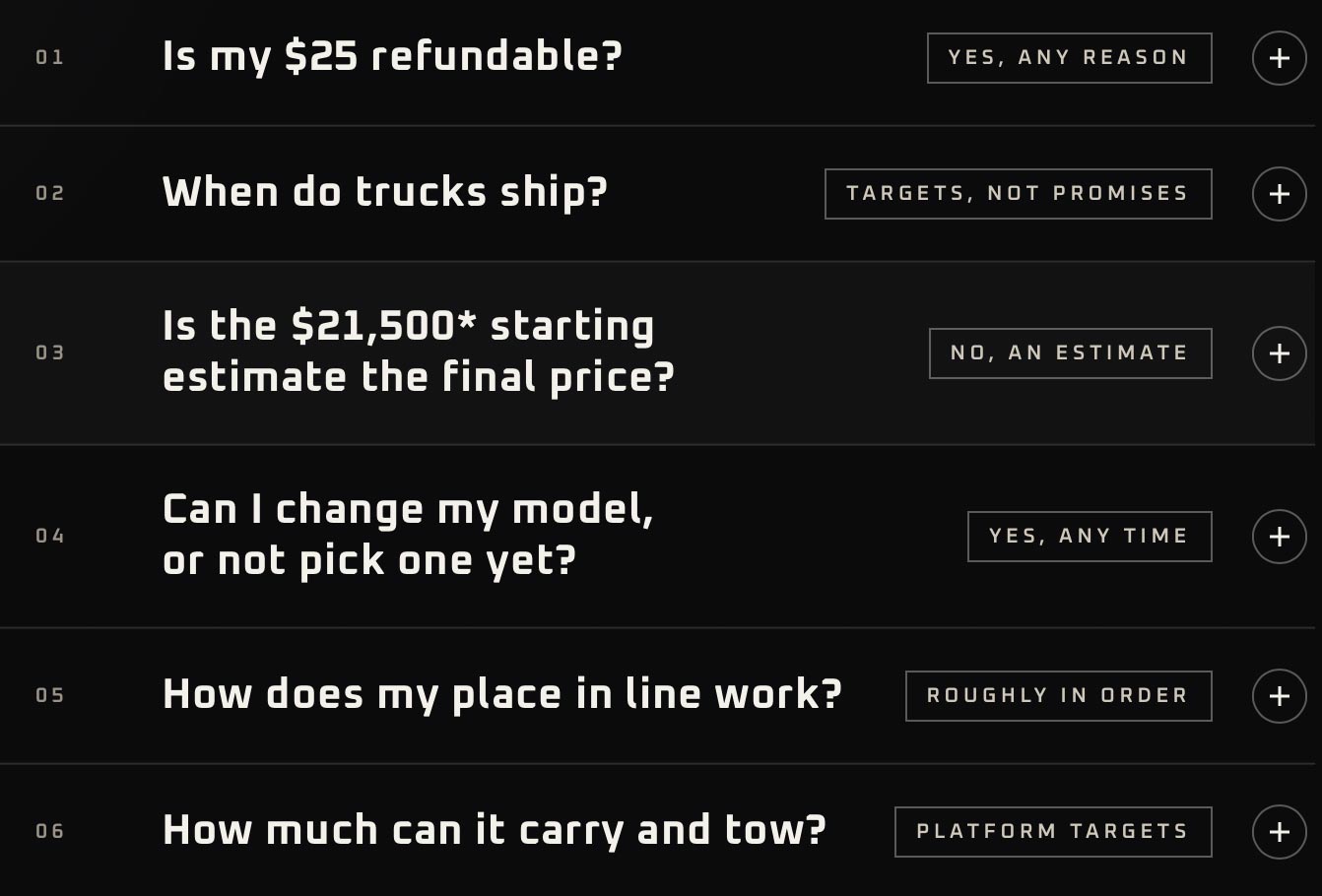
REO reported more than 32,500 paid reservations by September 2026, with refundable deposits of $25.
That’s encouraging evidence of interest, but reservations aren’t completed sales, and refundable deposits don’t establish that a company can manufacture vehicles profitably.
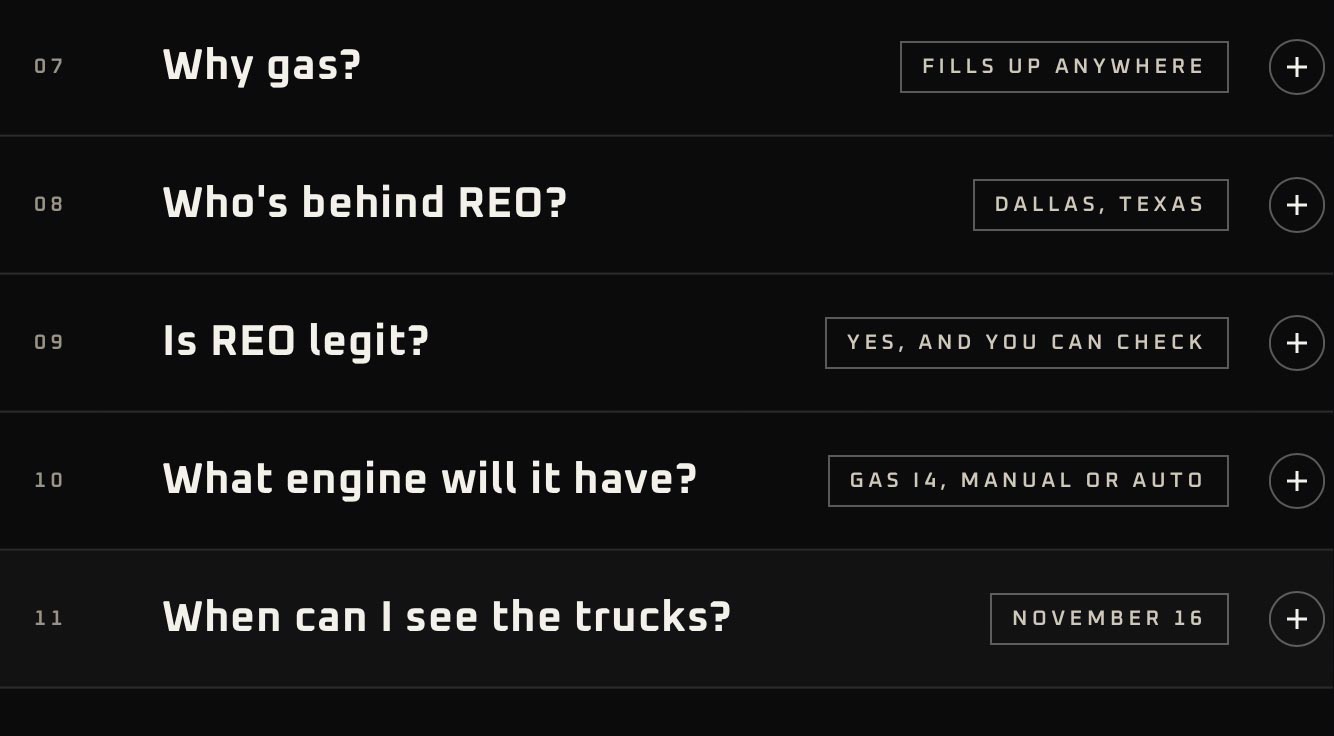
The announced schedule calls for a digital design reveal in late 2026 (potentially November 16th), pilot builds in 2027, and initial deliveries targeted for late 2028 or 2029. Those dates give us several milestones by which to judge the company’s progress. Will the final design retain the mechanical simplicity being promised? And will the target price survive development? Will the powertrain demonstrate the claimed durability? And will Omnimount become a real, supported engineering solution rather than an interesting development concept?
Perhaps most importantly, can REO build these vehicles in sufficient numbers to establish a sustainable business? We should want answers to those questions. Not because we want REO to fail… quite the opposite actually. When a company promises something this appealing, serious scrutiny is one of the best ways to distinguish a credible automotive project from another collection of impressive computer renderings.
Detroit Should Be Paying Attention…
Here’s what I find particularly interesting about REO. The company isn’t proposing a technology nobody’s ever seen. It isn’t promising a revolutionary propulsion system, autonomous driving breakthrough, or an entirely new form of transportation. It’s proposing a relatively small gasoline-powered truck with conventional construction, straightforward controls, accessible service information, and an emphasis on durability.
In other words, many of the things American manufacturers spent decades building before deciding customers needed something considerably more elaborate.
That’s not to say the established manufacturers have forgotten how to engineer simple vehicles. At least I don’t think they have. They understand manufacturing, logistics, powertrains, safety engineering, and vehicle development on a scale REO can only hope to achieve. But their business models have increasingly emphasized expensive trim levels, advanced technology packages, and high-margin vehicles.
REO is attempting to enter the market from the opposite direction.
Start with the essentials, make them dependable, and keep the vehicle affordable. Then allow owners to decide what comes next. It’s a philosophy that challenges more than just the price of a pickup truck. It challenges the relationship between the manufacturer and the customer. And that relationship is where the automotive industry has changed most dramatically in recent years.
We used to purchase vehicles with the expectation that we could maintain, modify, and eventually rebuild them. Today, ownership increasingly comes with technological conditions, software dependencies, and limitations. Some of those changes have legitimate engineering reasons, while others deserve far more scrutiny than they’ve received.
If REO can demonstrate that a modern vehicle can be profitable, safe, compliant, durable, and genuinely repairable without unnecessary proprietary restrictions, it could force a much larger conversation. And therefore…
The REO truck isn’t the revolution. But their philosophy is…
I’m not ready to declare REO the savior of the American pickup truck. The company still has an enormous amount to prove, and the distance between an ambitious concept and a dependable production vehicle is measured in years, engineering challenges, and extraordinary amounts of money. But I am genuinely interested in what REO is trying to accomplish. For years, we’ve watched vehicles become increasingly sophisticated while the average owner’s ability to understand, maintain, and modify them has become more restricted.
We’ve accepted higher prices/payments, more complicated systems, and an ownership experience that sometimes feels more like a licensing agreement than a purchase. And now – a small company in Texas is proposing a truck that – at least philosophically – wants to reverse that trend.
A truck with physical controls, accessible components, a conventional drivetrain, open repair information, and a platform intended to welcome the aftermarket rather than fight it. And an engine-mounting concept that effectively tells enthusiasts, “We know some of you are going to put something ridiculous under the hood. We thought about that.”
I love that. Because that possibility represents something that has been disappearing from the modern automotive experience.
Freedom.
The freedom to repair what you own. And the freedom to modify/customize it. The freedom to take care of it & keep it running long after the original manufacturer has moved on to the next generation. It’s the simple freedom to treat your vehicle as a machine that belongs to you… rather than a technological ecosystem you happen to be financing.
REO might succeed. It might struggle. And it might discover that the economics of modern automotive manufacturing are far less forgiving than the enthusiasm surrounding its ideas. But even if REO never delivers everything it’s promising… it’s already raised a question worth asking. Why does the idea of an affordable, durable, serviceable truck sound so revolutionary in an industry that spent more than a century building them?
Ransom E. Olds helped establish an American automotive industry built around making vehicles accessible to ordinary people. And now, more than a century later, a company carrying his initials wants to make ownership accessible again. I hope they pull it off. And if they eventually build a little Runabout that accepts a Ford Coyote without requiring a complete reconstruction of the engine bay, I suspect a few of us are going to make some exceptionally irresponsible financial decisions. After all, some traditions are worth preserving.
Article by David S. Windsor