
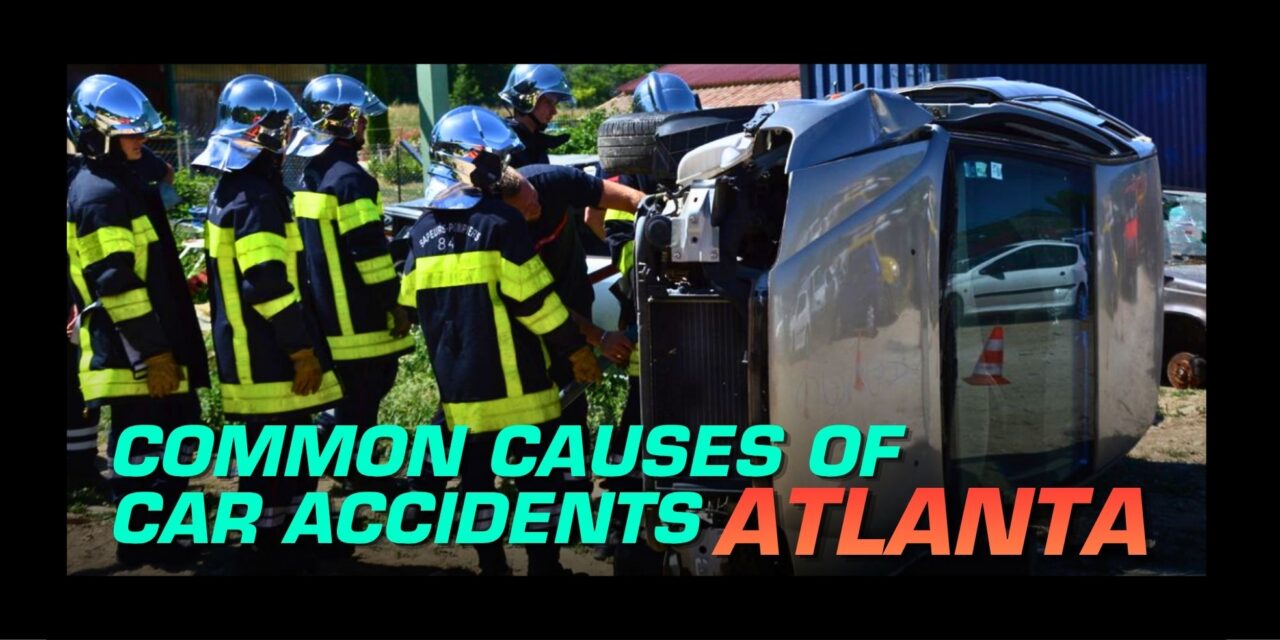

Atlanta’s roads have a reputation that locals know well — and the numbers confirm it. According to the Georgia Department of Transportation’s 2023 crash data, Fulton County alone recorded more than 30,000 reportable traffic crashes in a single year, making it one of the most collision-dense counties in the state. That’s not just a traffic statistic. Behind each number is a driver, a family, and often a legal situation that could have gone very differently with the right information.
What makes Atlanta uniquely challenging isn’t one single factor — it’s the convergence of several. The metro area ranks consistently among the worst in the country for traffic congestion, mixing aggressive highway driving on I-285 and I-85 with dense urban intersections, unpredictable weather, and a growing population of distracted drivers. The result is a road environment where accidents happen fast and the consequences linger.
For anyone who’s been in a collision here — or wants to avoid one — understanding *why* these crashes happen matters more than most people realize. Cause isn’t just a safety question; it directly shapes how liability is assigned, what evidence gets collected, and ultimately what compensation a victim may recover. This article examines Atlanta’s most common accident causes, explains how Georgia law connects those causes to legal outcomes, and outlines what to do when the unexpected happens.
Why Understanding Atlanta Accident Causes Matters Today…
Atlanta’s traffic landscape has shifted meaningfully over the past several years. The city’s post-pandemic population growth, combined with major infrastructure projects that have reshaped corridor traffic patterns along I-20 and the Downtown Connector, created new friction points that weren’t part of the metro driving experience a decade ago. Construction zones, lane closures, and detours push unfamiliar drivers into routes they don’t navigate well — and that unfamiliarity breeds mistakes.
But local context goes deeper than road construction. Atlanta sits at the intersection of southern driving culture and fast-paced urban commuting, which produces some genuinely unusual collision patterns. Drivers moving in from other cities often underestimate how quickly Atlanta’s elevated highways demand lane changes. Meanwhile, local drivers sometimes develop a comfort with aggressive merging and high-speed following distances that would be considered reckless in slower metro areas.
There’s also the weather dimension. While Atlanta doesn’t face the brutal winters of northern cities, its occasional ice events and heavy thunderstorms — especially during spring and summer storm seasons — create disproportionate crash spikes. Drivers largely unprepared for slick roads can lose control even at moderate speeds.
Understanding these causes matters practically because car accident claims don’t exist in a vacuum. When someone is injured in a collision caused by another driver running a red light in Midtown versus someone hydroplaning on I-75 during a downpour, the legal analysis looks very different. The cause determines who bears fault, what physical evidence is relevant, and how hard an insurance company will fight the claim. Knowing the “why” behind an Atlanta crash isn’t background noise — it’s foundational to everything that follows legally.

Most Common Causes of Car Accidents in Atlanta and Their Impact…
Several causes account for the large majority of Atlanta’s crashes — and most of them are preventable. Recognizing the patterns doesn’t just make for a safer commute; it frames the legal conversation in a way that actually helps injured drivers protect their rights.
Key Specific Causes Behind Atlanta Car Crashes
Distracted driving leads the list, and it shows no signs of slowing down. Phone-use while driving remains a primary trigger, but Atlanta’s stop-and-go traffic creates a false sense of safety — drivers stuck in gridlock on GA-400 feel justified glancing at navigation apps or catching-up on messages, then fail to react when traffic suddenly moves or stops again.
Speeding is equally pervasive, particularly on Atlanta’s elevated highway system. The stretch of I-285 known informally as “the Perimeter” sees sustained speeds well above posted limits during off-peak hours, turning minor vehicle malfunctions or sudden lane changes into serious collisions.
Failure to yield dominates urban intersection data, especially around high-traffic areas like Buckhead, Midtown, and the Five Points corridor. Left-turn accidents — where a turning driver misjudges oncoming traffic speed — are among the most injury-producing crash types in the city.
Impaired driving spikes notably on weekend nights and around major events at venues like State Farm Arena and Mercedes-Benz Stadium, where high volumes of drivers are traveling unfamiliar routes after consuming alcohol.
Adverse weather conditions, particularly the flash flooding and sudden ice events Atlanta experiences, consistently factor into multi-vehicle collisions on interstate ramps and overpasses.
How These Causes Affect Liability and Injury Claims
Each of these causes carries distinct legal weight. A distracted driver who rear-ends someone at a light presents a fairly clear negligence argument — phone records, witness accounts, and dashcam footage can establish fault with relative directness. Speeding cases often hinge on physical evidence: skid marks, point of impact, and accident reconstruction analysis.
Weather-related accidents get more complicated. If a driver hydroplanes and strikes your vehicle, the question becomes whether that driver exercised reasonable caution given the conditions — did they slow down appropriately, maintain safe following distance, or choose to drive when the risk was obvious? The weather itself isn’t the defendant; the driver’s response to it is.
Yield violations and impaired driving tend to produce stronger liability arguments for injured parties, but documenting them quickly matters. Field sobriety results, traffic camera footage, and officer notes from the scene all have time-sensitive relevance to building a successful claim.
How Liability Is Determined in Atlanta Car Accident Cases…
Georgia operates under a modified comparative negligence system — a framework that significantly affects what injured drivers can actually recover. Under Georgia Code § 51-12-33, a plaintiff can recover damages as long as they are found to be less than 50 percent at fault for the accident. However, their compensation is reduced proportionally by their share of fault. If a court determines you were 20 percent responsible for a collision, your award is reduced by 20 percent.
This matters enormously in practice. Consider a driver who was speeding slightly when a distracted driver ran a stop sign and struck them. The at-fault driver’s insurer may argue that the speeding contributed to the crash and try to assign partial fault to the victim. That argument, if it succeeds, reduces the claim’s value — and if it reaches 50 percent or above, it eliminates recovery entirely.
Insurance adjusters understand this leverage. They use it early and often, which is one reason why the cause of an accident and the evidence supporting it become so critical immediately after a collision. Claimants who can clearly demonstrate the other driver’s negligence — through photographs, witness statements, traffic camera data, and police reports — are in a far stronger position to resist comparative fault arguments.
For more complex accidents, especially those involving commercial vehicles, rideshare drivers, or multiple parties, individuals pursuing car accident representation in Atlanta often benefit from legal counsel who can identify all liable parties and build a fault narrative before the insurance company establishes its own version of events.
Georgia’s statute of limitations for car accident injury claims is two years from the date of the accident under O.C.G.A. § 9-3-33, with separate timelines for property damage. Missing that window forfeits the right to sue regardless of how clear the liability is.
Steps to Navigate the Legal Process After an Atlanta Car Accident…
Building on the liability framework above, the actions taken in the hours and days following a crash directly determine what’s available to work with legally. Evidence deteriorates fast — skid marks wash away, witnesses become harder to locate, and physical injuries that go undocumented early can be characterized later as pre-existing or unrelated.
At the scene, priority goes to documenting everything photographically: vehicle positions, road conditions, traffic signals, and any visible injuries. If there are witnesses, collect their contact information before they leave. A police report is essential — in Georgia, crashes involving injury, death, or property damage over $500 require officers to file a report, and that document becomes a foundational piece of the legal record.
Medical evaluation should happen within 24 hours even when injuries feel minor. Adrenaline frequently masks soft tissue injuries and concussions in the immediate aftermath of a collision. A delay in medical care creates an insurance defense argument that the injuries weren’t serious — or weren’t caused by the accident at all.
When dealing with insurance companies, recorded statements deserve caution. Adjusters are trained to ask questions that elicit admissions of partial fault or minimize injury descriptions. Claimants aren’t required to provide recorded statements to the other driver’s insurer, and agreeing to do so before understanding the full picture of injuries and damages can undercut a claim significantly.
Compensation in Georgia car accident cases can include medical expenses, lost wages, property damage, and non-economic damages like pain and suffering. What that figure looks like depends on the severity of the injuries, the clarity of fault, and how thoroughly the damages were documented from the start.
Preventing Car Accidents in Atlanta Using Local Insights…
Prevention in Atlanta has to account for its specific conditions. Generic driving safety advice — “don’t text and drive” — doesn’t capture the real-world complexity of navigating the city’s highway system during an afternoon storm or merging onto I-75 from a compressed on-ramp during peak hours.
The most practical adjustment Atlanta drivers can make is expanding their following distance well beyond the standard three-second rule in congested or wet conditions. The city’s short but intense rain events make stopping distances unpredictable, and tailgating in those moments turns routine slowdowns into rear-end chains.
Planning routes around known high-risk intersections — particularly those in Midtown and near stadium corridors on event nights — reduces exposure to yield violations and impaired drivers. Apps that show real-time incident data give drivers a legitimate reason to reroute before entering a congestion zone where distracted behavior spikes.
Highway merging deserves specific attention. The I-285/I-85 interchange consistently appears in Georgia DOT incident reports, and many of those crashes involve drivers making last-second lane changes without sufficient speed matching. Entering highways at traffic speed, signaling early, and avoiding the right lane near high-density exit clusters dramatically reduces exposure at these flashpoints.
The question worth sitting with isn’t whether you drive carefully — it’s whether your habits were built for Atlanta’s specific road environment, or transplanted from somewhere much simpler.